Supreme Court Ruling on FLSA: A Game Changer for Employers and Workers
AI-generated based on this event

TL;DR
The U.S. Supreme Court has lowered the burden of proof for employers defending against overtime pay lawsuits under the Fair Labor Standards Act (FLSA). This decision could lead to cost savings for companies but may also increase legal challenges and scrutiny over worker classifications.
Introduction
In a landmark decision, the U.S. Supreme Court has altered the legal landscape for employers and employees alike by lowering the burden of proof required for defending against overtime pay lawsuits under the Fair Labor Standards Act (FLSA). This analysis delves into the implications of this ruling, exploring its potential impact on businesses, workers, and the broader legal framework. Investors and stakeholders should pay close attention to how this decision might influence corporate strategies and labor relations in the coming years.
Background
The Fair Labor Standards Act (FLSA) was established to protect workers by setting minimum wage, overtime pay, and other employment standards. The recent Supreme Court ruling, authored by Justice Brett Kavanaugh, has overturned a previous decision by the 4th U.S. Circuit Court of Appeals, which required a higher standard of proof—'clear and convincing evidence'—for employers to classify workers as exempt from overtime pay. Instead, the Court has now aligned the burden of proof with the 'preponderance of the evidence' standard commonly used in civil litigation. This decision arose from a case involving EMD Sales, where sales workers contested their classification as outside sales employees, claiming they were unfairly denied overtime pay. The ruling not only remands the case for further consideration but also sets a precedent that could reshape the application of FLSA exemptions across various jurisdictions.
Scenarios Analysis
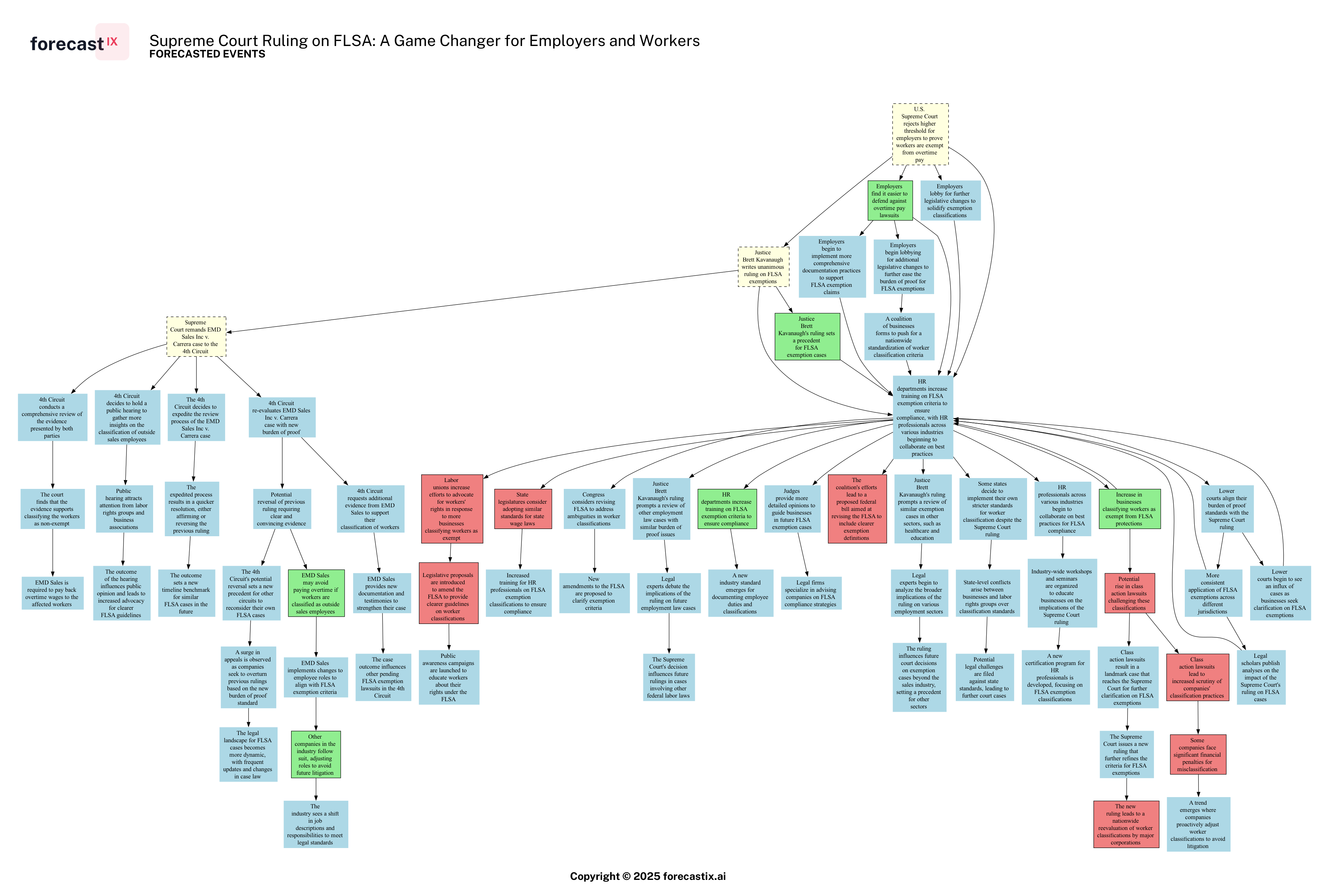 Forecasted chain of events following the Root Events from the base article (yellow). AI-generated.
The Supreme Court's recent ruling on the Fair Labor Standards Act (FLSA) exemptions has set the stage for a fascinating array of potential scenarios in the employment law landscape. With the decision to lower the burden of proof for employers, we could see a significant shift in how businesses approach worker classification. One intriguing possibility is that employers might find it easier to defend against overtime pay lawsuits, leading to a potential increase in businesses classifying workers as exempt from FLSA protections. This could, in turn, spark a rise in class action lawsuits challenging these classifications, as workers and their advocates push back against what they may perceive as an erosion of employee rights.
Moreover, the ruling penned by Justice Brett Kavanaugh may set a precedent for FLSA exemption cases, prompting lower courts to align their burden of proof standards with the Supreme Court's decision. This alignment could result in a more consistent application of FLSA exemptions across different jurisdictions, reducing the patchwork of interpretations that currently exists. However, this consistency might also lead to a surge in appeals, as companies seek to overturn previous rulings based on the new standard, creating a dynamic and ever-evolving legal landscape.
In response to these changes, labor unions and worker advocacy groups might ramp up their efforts to protect workers' rights, potentially leading to legislative proposals aimed at amending the FLSA to provide clearer guidelines on worker classifications. Public awareness campaigns could also play a crucial role in educating workers about their rights under the FLSA, ensuring they are informed and prepared to challenge any misclassifications.
On the business side, we might witness a trend where companies proactively adjust worker classifications to avoid litigation, leading to a shift in job descriptions and responsibilities to meet legal standards. This proactive approach could be accompanied by increased training for HR professionals on FLSA exemption classifications, fostering a new industry standard for documenting employee duties and classifications.
Finally, the ruling could have broader implications beyond the sales industry, influencing future court decisions on exemption cases in other sectors such as healthcare and education. As legal experts begin to analyze the ruling's impact, we may see a ripple effect across various employment sectors, setting a precedent for how exemption cases are handled in the future. This could lead to a nationwide reevaluation of worker classifications by major corporations, as they seek to align with the evolving legal standards and avoid potential legal challenges.
Impact Analysis
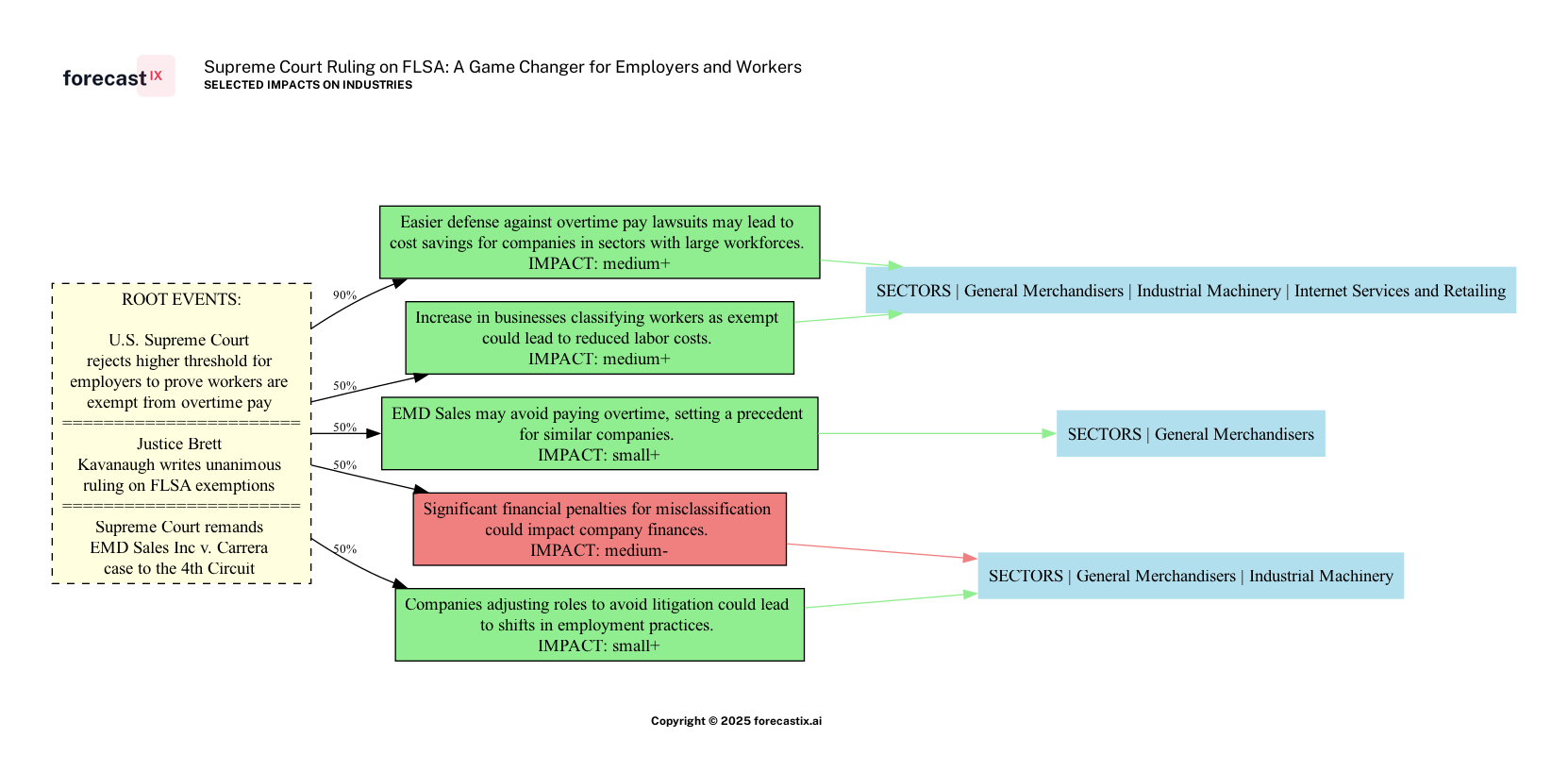 Selected forecasted impacts on industries. Note various likelihood, strength, and direction. AI-generated.
The recent Supreme Court decision to lower the burden of proof for employers defending against overtime pay lawsuits under the Fair Labor Standards Act (FLSA) is poised to create ripples across several sectors, particularly those with large workforces. This ruling could potentially lead to significant cost savings for companies by simplifying the defense against such lawsuits. Retail giants like Amazon, Walmart, and Target, along with other major players in the general merchandisers and industrial machinery sectors, stand to benefit from this change. By easing the legal burden, these companies may find it more feasible to classify workers as exempt, thereby reducing labor costs.
However, this decision is not without its potential downsides. The increased likelihood of businesses classifying workers as exempt could trigger a rise in class action lawsuits, which might offset some of the cost savings with increased legal expenses. Companies such as Dover Corporation, Wabtec, and Carrier Global, which are part of the industrial machinery sector, could face significant financial penalties if misclassification is proven, impacting their financial health.
Moreover, the ruling could set a precedent that streamlines legal processes in FLSA exemption cases, potentially leading to a nationwide reevaluation of worker classifications. This could necessitate operational changes across various sectors, prompting companies to invest in increased training on FLSA exemption criteria to improve compliance.
In the broader landscape, this decision might spur legislative proposals aimed at altering labor laws, which could have far-reaching implications for employer practices. The potential for increased advocacy efforts by labor unions could also influence how companies approach worker classification and compensation.
In summary, while the Supreme Court's ruling offers a pathway to reduced labor costs and simplified legal defenses for companies, it also opens the door to increased scrutiny and potential financial penalties, underscoring the complex interplay between legal standards and business practices.
Investor Takeaways
- Monitor Legal Developments: Investors should stay informed about ongoing legal developments and potential legislative changes that could impact labor laws and worker classification standards. This knowledge will help in assessing the risks and opportunities associated with companies that are heavily reliant on workforce management.
- Evaluate Company Strategies: Pay close attention to how companies in sectors like retail and industrial machinery adjust their workforce strategies in response to the ruling. Companies that proactively align their practices with the new legal standards may present more stable investment opportunities.
- Assess Litigation Risks: Be aware of the potential for increased litigation risks, particularly class action lawsuits, which could affect companies' financial health. Investors should consider the legal track record and compliance strategies of businesses when making investment decisions.
Conclusions
The Supreme Court's decision to lower the burden of proof for FLSA exemption cases marks a significant shift in the legal landscape for employers and employees. This ruling not only changes the dynamics of worker classification but also sets a precedent that could influence future court decisions and legislative actions. For businesses, this presents both opportunities for cost savings and challenges in terms of potential legal liabilities.
As the dust settles, companies will need to navigate this new terrain carefully, balancing the benefits of reduced labor costs with the risks of increased scrutiny and litigation. Investors, in turn, should keep a keen eye on how these developments unfold, as they could have profound implications for corporate strategies and financial performance.
In the ever-evolving world of employment law, staying informed and adaptable is key. As the saying goes, "The only constant is change," and in this case, the change could redefine the future of labor relations and business practices across the nation.